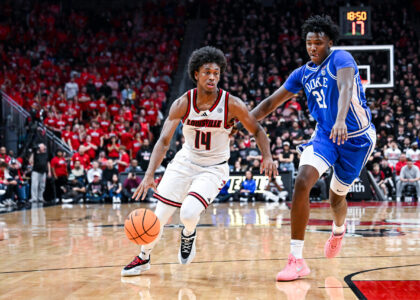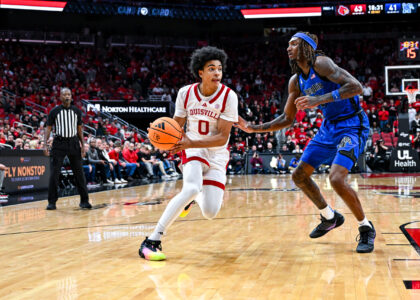
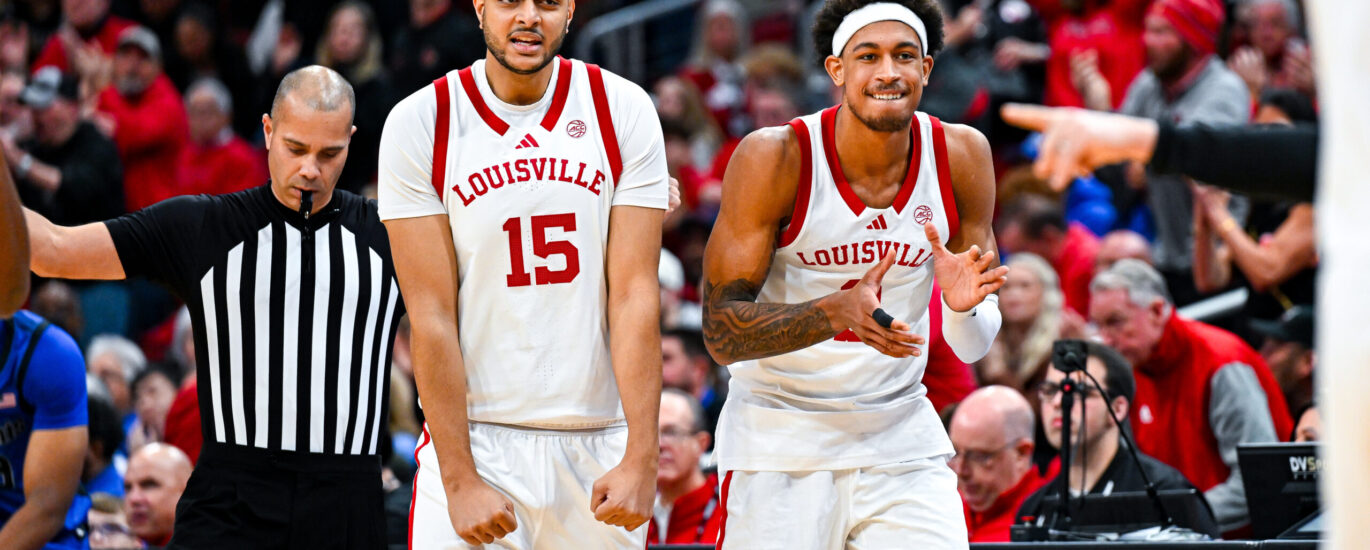
With Louisville basketball’s seeding possibilities becoming clearer, the Cardinals may find a sweet spot for a potential run in March.
It’s our favorite time of year in Louisville, Kentucky.
This morning, I woke up to birds chirping outside my open bedroom, the smell of a blooming Bradford Pear wafting into the room, and kiddos waiting for the bus in shorts and t-shirts.
Perhaps more excitingly, it’s the time on the sports calendar that we dream about. Baseball is in full swing, the Masters is just around the corner, and your work printer is about to be putting in overtime as Darcy in accounting aims to piss you off once again by picking all of the right upsets.
Every March, the NCAA tournament reminds us that while seeding matters, it certainly doesn’t define the outcome. If the bracket projections hold, Louisville basketball will likely enter the NCAA Division I Men’s Basketball Tournament on or around the 6-seed line — A spot that historically sits right in the middle of the bracket’s chaos. It’s not quite a Cinderella position, but it’s also far enough down the seed line to avoid the pressure of the favorites.
History shows that teams in this range absolutely can make deep runs. In fact, the blueprint already exists.
Two 6-seeds have reached the national title game. The most famous example is the Kansas, which won it all in 1988.
Led by former Louisville basketball assistant Danny Manning, the Jayhawks rode a dominant star performance all the way through the bracket.
Four years later, Michigan made the championship game as a 6-seed in the 1992 NCAA Division I Men’s Basketball Tournament, powered by the Fab Five.
Then there’s an even more recent example from just outside the 6-line. 7th-seeded UConn ended up winning the national championship over 8-seed Kentucky.
If that run proved anything, it’s that once the bracket opens up, seeding becomes far less predictive.
What These Teams Had in Common
Despite coming from different eras, those teams shared several traits that matter in March.
First, they had elite guard play. The 2014 UConn team was driven by Shabazz Napier, who controlled the tempo of every game. Michigan’s 1992 run was orchestrated by the guard-heavy Fab Five group, with players like Jalen Rose and Chris Webber dictating matchups. Even Kansas in 1988, though built around Manning, relied heavily on perimeter shot-making to stretch defenses.
Secondly, those teams peaked late in the season. None of them dominated wire-to-wire. Instead, they entered March playing their best basketball, often after dealing with injuries or inconsistency earlier in the year.
Third, they had a clear identity. UConn defended at a high level and executed late-game offense through Napier. Kansas relied on Manning’s versatility. Michigan overwhelmed teams with talent and pace.
When mid-seed teams reach the title game, it’s rarely because they suddenly become something different. It’s because they fully become what they already are.
How Louisville Fits That Blueprint
That’s where Louisville basketball can be an interesting case study as a team primed for a deep run in March.
The Cardinals’ ceiling largely revolves around the health of Mikel Brown Jr.
While Louisville has done well to stay afloat without him, when Brown is healthy, its offense looks significantly different. His ability to create off the dribble, push tempo, and collapse defenses gives the Cardinals a level of backcourt control that mirrors the guard-driven teams that have made surprise runs in the past.
March often comes down to shot creation when plays break down. Teams with guards who can generate offense late in the shot clock tend to survive the tournament’s tight games. That’s something that Louisville basketball fans became accustomed to in past postseason runs. From Darrell Griffith to Peyton Siva, ball-dominant guards who can get downhill and create something from nothing have spoiled the hopes of great teams in the postseason.
Louisville also brings a trait that matters more than many fans realize: defensive toughness. In recent tournament history, teams making unexpected runs almost always defend at a top-20 level nationally in efficiency. Defense travels, especially in neutral-site environments where shooting can fluctuate.
While Louisville fans are accustomed to having a top-5 defense, Louisville ranks 30th in KenPom’s defensive metrics and 26th on EvanMiya.com — Which is good enough for the ACC’s top offense to survive and advance.
If Brown returns to full health, Louisville’s combination of guard play, defense, and half-court shot creation fits a recognizable March profile.
A Different Kind of Bracket
Another factor that could shape Louisville’s path is the broader structure of this year’s bracket.
By most measures, this season is top-heavy. The projected 1-seeds (Duke, Michigan, Arizona, Florida) have had historically strong seasons.
Teams at the 2-through-5 seed lines also look deeper and more complete than we often see.
Squads like UConn, Iowa State, and Illinois are positioned to make some noise in March. Louisville fans know all too well that a team like St. John’s shouldn’t be written off with Rick Pitino pacing the sidelines.
At the same time, the bubble appears unusually weak.
Every year, analysts say the bubble is soft, but that claim has some substance in 2026. Teams like SMU, Stanford, Missouri, Texas A&M, and even Auburn are still fighting for tournament spots despite inconsistent resumes.
That dynamic could lead to a chalk-heavy first weekend. If the gap between the middle seeds and the bubble teams is wider than usual, many of the early matchups will favor higher seeds even more heavily.
For a team like Louisville, that’s not necessarily bad news.
If chalk holds through the first weekend, the tournament becomes more about matchups between legitimate teams rather than surviving the randomness we’ve come to expect in March. In other words, if the Cardinals reach the Sweet 16, they seem likelier to be facing a lower-seeded time, but they’ll also be exactly where teams with their profile tend to make their move.
The Path for Louisville
For Louisville basketball to make a run, several things likely need to happen.
First, Mikel Brown has to be healthy enough to control games. Guard leadership is almost non-negotiable for mid-seed teams making deep runs.
While Louisville has seen some great contributions from his backcourt mates Ryan Conwell and Adrian Wooley of late, this certainly feels like a moment where you need your star point guard to step up when the lights are brightest.
Second, Louisville will need to win the possession battle. Limiting turnovers, rebounding effectively, and forcing opponents into half-court situations.
In Louisville’s final 4 games, it only turned the ball over 8 times per game — A notable drop-off from its 11.3 turnovers per game in conference play. In its final two matchups against Syracuse and at Miami, Louisville only turned the ball over 7 and 6 times, respectively. It only allowed 9 points off of turnovers over those two games while averaging 18 points gained off turnovers.
Third, they must avoid the one weakness that has historically derailed good tournament teams: offensive stagnation. The tournament punishes teams that go long stretches without scoring. Shot creation late in possessions becomes the difference between advancing and going home.
The encouraging part is that Louisville has already shown flashes of the type of basketball that works in March: physical on-ball defense, controlled tempo, and guards capable of creating their own offense.
Finding the Sweet Spot
Ironically, the 6-seed line may actually be the sweet spot for a team like Louisville.
The opening matchup against an 11-seed is rarely easy, but it avoids the coin-flip nature of the 8 vs. 9 game. 6-seeds have gone 98-62 vs. 11’s in the modern era, and get to the second weekend far more often. Importantly, it keeps Louisville away from the region’s top two seeds until later in the bracket.
History shows that once a team in that range reaches the second weekend, the gap between seeds begins to shrink dramatically.
Kansas proved it in 1988. Michigan showed it in 1992. UConn reminded everyone in 2014.
If Louisville enters the tournament healthy — especially with Mikel Brown back to full strength — the Cardinals will have something every dangerous March team needs: a clear identity, a capable backcourt, and just enough seeding room to surprise people.
And in a tournament built on unpredictability, that combination has been enough before.