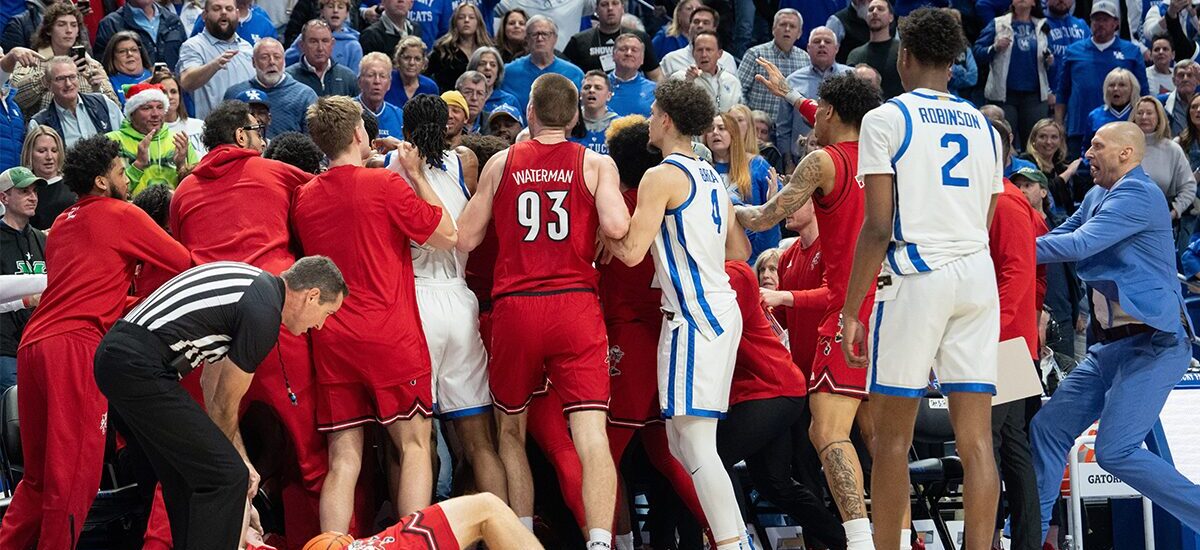
As a Louisville basketball fan, hating Kentucky is a way of life.

Rivalry is one of the most universal and vital aspects of sport. There are thousands of teams across the spectrum of American athletics, and every one of them, from preschoolers to professionals, has an arch nemesis that frames their understanding of themselves, their sport, and, sometimes, general human morality.
Pat Kelsey is getting his Louisville basketball team ready to play Mark Pope’s Kentucky Wildcats on Tuesday for just the second time in his tenure at Louisville. The modern era of college athletics encourages athletes to constantly be on the move, motivated more by the pursuit of the payday than anything else. Hence, players forming four year relationships with fans and foes is increasingly rare in the NIL era. Combine that with the fact that both Kelsey and Pope are such likable coaches, and the result is a storied rivalry whose temperature can feel somewhat temperate today, at least in comparison with the eras headlined by Pitino, Calipari, Crum, and Hall. Tuesday’s basketball game is earlier than football for the first time in my life, neither team has played enough games to have solidified an identity, and both programs are in just the second season of their new epochs.
In preparation for Battle for the Bluegrass, my original intention was write up a preview of the matchup: what do the Cards need to do to win? What makes Kentucky formidable? Who is who on Kentucky’s top ten team? Yet, as I embarked on this endeavor, I found myself hesitating…is this what I wanted to write? Does the state of Louisville need more of that content? I’ve been to every home game this season, and, more than an analysis of the opposition, what the fan base needs is a shot in the arm. Let’s get fired up about the team Kelsey has built, and the chance to do the seemingly impossible: shut Kentucky fans up!
For those who haven’t seen the Cats play this year, here is a summation of what they do: Kentucky is long, athletic, shoots well, shares the ball masterfully, and thrives in transition. They beat preseason number one Purdue in an exhibition with two Wildcat starters sitting out (though Purdue claims that they didn’t scout the game). Kentucky plays fast but not rushed, has a great coach that imported a potent combination of proven transfer talent and promising freshmen, and is undoubtedly deserving of its preseason national ranking: all of this could likewise be said about Louisville, by the way. I have, therefore, decided to take this piece in a different direction, choosing instead to remind Cards fans what makes Kentucky our most bitter rival, and hating Big Blue Nation our birthright. We all have reasons why we can’t stand ‘em, but here are some I hold close to my heart.
Preview the rivarly with Starting Five02 Podcast –
Article continues below.
Civility has always been a war
One of the essential aspects of a great rivalry is history. Legitimate hatred between teams is built upon decades of disdain. To really understand the animosity between the Cardinals and Kentucky, you have to go back, before sports and schools, to the original American rivalry: the Civil War. It is here, in the conflict that saw brothers draw blood from one another, that the geographic divisions largely defining the fan bases today were drawn. Outside of Louisville, the Commonwealth is almost entirely Wildcat blue, while Jefferson County is divided, but generally Cardinal red.
Similarly, Louisville was a Union port during the War, being a major supply hub on the Ohio River for Lincoln’s army. Though the rest of the state was neutral on paper, 93% of slaves in Kentucky lived outside of Louisville, and the majority of the state depended on agriculture to subside: the loss of slavery had a profound impact on Kentucky’s economy, especially outside of Louisville.
I don’t think the city has ever been forgiven for its Union allegiance. Shortly following the end of the Civil War, the second Expatriation Act forgave Confederate treason, (effectively giving traitors a pass on a crime otherwise punishable by death) and the University of Kentucky opened its doors in 1865 as an agriculturally-focused institution.
The University of Louisville, in spite of being founded in 1798, was the academic extension of a city that stood against the Confederacy (in spite of southern sympathy from some of its most famous citizens, like Henry Watterson). Louisville would never be Kentucky’s capitol, though it is undoubtedly the most important metropolis in the State (10th largest in America at the time), Lincoln would never be its President (in spite of being born in the Bluegrass), and the Commonwealth’s citizens would never embrace the city, or it’s University.
The ghosts of these politics haunt Kentucky athletics to this day: Louisville feels as different and disconnected from the rest of Kentucky as the fan bases are from one another. The 502 is a progressive oasis in comparison to the ocean of closed-off conservatism that is the rest of the Bluegrass State and red and blue politics are mirror images of the same color-coded athletics. Outside of Jefferson County, it is tragically common to see Confederate colors flying still, often under a MAGA flag (but we’ve established that treason plays well with this crowd), and a Wildcat blue almost always accompanies Rebel stars and bars. Every time I pass a trailer flying these flags, I am reminded why it is that I tell people I’m from Louisville, not Kentucky.
NIT vs. NCAA
Here’s a factual farce that I’ve had shoved in my face my entire life: the University of Kentucky has won 8 NCAA titles, making it the greatest program in the history of blah, blah, blah. I remember my 5th grade year: Pitino was at the zenith of his Kentucky coaching success while Denny Crum was on the verge of semi-forced retirement. Kentucky would make it to the season’s final game two years in a row, while the Cards failed to even make the tournament. Cat fans would mock Freedom Hall because we recognized NIT championships in our rafters, while they only dealt with “banners that matter,” as if our program would hang anything to fill up ceiling space (I suppose, though, as the people that gave the world lynching, they are experts in hanging).
Here’s the piece of this puzzle that never seems to find its place in these conversations: the NIT used to be the premier post season college basketball tournament. In 1952, the NCAA Tournament expanded from eight to sixteen teams, at which point it can be seen as stepping into a position of exalted prominence. Yet, as late as 1970, Marquette Coach Al McGuire, unhappy with his draw in the NCAA Tournament, voluntarily chose to participate in the NIT in spite of being ranked 8th nationally. Even if we use ’52 as the point of separation, that means that, at the very least, three of Kentucky’s eight championships (1948, 1949, and 1951) were, if not banners that didn’t manner, banners that didn’t matter as much. This has always represented, to me, a mischaracterization of the truth for the purposes of artificially inflating their legacy. What should you expect, though, from the same folks who claim the Civil War was about heritage, and not bondage?
Brothers in Arms
Of all the condescending comments Cardinal fans must endure, nothing gets under my skin like the notion of being Kentucky’s “little brother.” Our city is bigger, our University is older, and our program has historically been more profitable. Add to that the fact that Kentucky has often attempted to weasel out of playing the Cards when they found it favorable to do so makes evident the ridiculousness of Louisville being the runt sibling. For example, the Cats successfully ducked Crum’s Cards until the teams met in 1983’s Dream Game.
Even now, there are whispers that the football series might be cancelled. They can blame it on conference scheduling as much as they want to, but it will never be coincidence to me that these discussions always seem to come about when one of Louisville’s programs is on the upswing. We never heard about UK having no room on their football schedule for the Governor’s Cup when they were on a five year win streak! So I have a hard time understanding how we’re the “little” ones in their minds.
The Calipari Experience
I don’t think that, in my lifetime, UK was ever more detestable to me than when they entered the John Calipari era.
Now, before I go in on him, let me say this: I happen to know for a fact that Calipari is a good man. He genuinely cares about his players, is a devout Catholic, is personally involved with several charitable organizations, and goes out of his way to elevate people’s days around him. My Uncle interviewed Cal once about one of his charities. Not only was Cal gracious enough to grant him the interview, but also they attended a closed practice the next day. Cal even remembered their names. It also helped soften my stance on him when he left Kentucky high and dry to coach at another SEC school.
Now, that being said…I hated John Calipari before he ever got to Kentucky. I thought he was the coaching equivalent of a used car salesmen at UMass and Memphis, so when Calipari was hired by UK, essentially pulling the program out of the gutter in one fell swoop, there were few human beings I begrudged more intensely than him. Having watched Kentucky fans run Tubby Smith out of town, in spite of being consistently successful for his entire tenure, I felt that UK deserved to spend some time losing: maybe then they would appreciate the exceptional teacher and human being that was Orlando Smith. Tubby seemed to pay more for his losses than other coaches would have, and the fan base got racial at the drop of a hat when he didn’t win. Remember when they put ‘For Sale’ signs in Smith’s front yard in the middle of the season?
BBN jumped onto the Billie Gillespie train almost as quickly as it went off the tracks, and Gillespie fell off the wagon. Tubby was a good man and coach, and Big Blue Nation deserved to wallow in the vacuum created by the failed Gillespie experiment. So when Kentucky went from being a faltering program with a drunk for a coach to a title contender with six first rounders on the team over night, it felt like Cats’ fans were again getting something they didn’t deserve, and getting it too quickly. To make matters even more frustrating, it was done by embracing a recruiting philosophy that seemed to destroy everything about college basketball that makes it so magical.
Call me old fashioned, but Pitino’s style felt both effective and moral: he emphasized effort, defense, paying your dues, and player development. Coach P preferred to recruit players who fit into a culture that centered on the front, not the back, of the jersey. Guys stuck around, which is how you got your Siva’s, Smith’s, and Garcia’s. Ellis Myles came in drastically over weight and egotistical, and left in incredible mental and physical shape. He over-achieved and triple-doubled his way into being one of our all-time greats after being told to find another place to play after his first season These feel-good stories defined Cardinal basketball under Pitino, and Calipari’s Cats were the antithesis of this brand of basketball.
And Calipari was, often, like Kryptonite to Pitino’s teams. His one-and-done movement exemplified everything that I find unfortunate about athletics, and it was as shameless as it was remarkable how seamlessly Big Blue Nation got behind it. A program that professed to be the Mecca of college basketball had no issue with the destruction of its college aspect. They even celebrated Anthony Davis’ uni-brow by binding their own with a blue bridge: “bow to the brow.” Who endorses a uni-brow?!
And the rivalry went beyond basketball during Cal’s time at UK. Not only was DeMarcus Cousins dropping the corporate elbow on Jared Swopshire during their first meeting, but there was over-compensating competition off court. Kentucky undercut Louisville, partnering with WHAS to broadcast their games exclusively. I had been hearing the Cards play on 840 my entire life, and the station was located within Louisville, but UK decided they wanted our air time. The Cats insisted on playing a game in Freedom Hall every year after we moved to the Yum! Center: can you imagine Louisville ever booking a matchup in a UK facility without playing the Wildcats? Calipari put out books that looked like carbon copies of ones Pitino authored.
What was truly petty, though, was the jewelry wars. Pitino started doing radio commercials for the Shane Company when he got the job as the Cards’ coach. Shortly after taking over in Lexington, Calipari endorsed Genesis Diamonds. While this may sounds harmless at first, keep in mind that long before he coached the Cats, Calipari was asked about the difference between Pitino and him. One of his retorts was that “he wears Gucci shoes, I wear itchy shoes,” essentially leaning into the blue collar, working man persona he so carefully cultivated. So the idea of him having a preferred jeweler was very off brand for Cal. Even listening to the Genesis commercials, they felt completely reactionary to Pitino’s Shane Company campaign, in the same way that the very hiring of John Calipari felt like a reaction to Pitino taking over in Louisville.
But, in typical Kentucky fashion, as soon as their program experienced the slightest bit of “adversity,” which they defined as not getting to the Final Four annually, they were ready to fire Calipari. If you really think about the type of season he had in his last year at Kentucky, and the fact that his head was on the chopping block because of an early tournament exit, it’s as typical as it is infuriating: they gave him the crown as quickly as they sent him to the gallows.
A team underperforming in the postseason is understandable when it’s built exclusively on freshman talent and everyone is still reeling from the giant curveball that was COVID. The one-and-done sword was double edged, and the Kentucky fan base that was so enthusiastic about freshmen talent basketball when it was winning for them could not cope with all the consequences of being a talent pipeline for the NBA.
They always expect to have their cake and eat it, too: if they cannot, something is awry. Why? Because, of the many words I could use to describe Big Blue Nation (arrogant, frustrating, irrational, toothless), the one that comes to mind most often is entitled. They’re never satisfied and always deserving, better than everyone but never good enough, the kind of folks that often ascribe to the belief that something is as true as it is loud: sometimes being in the same state as them feels like living in an echo chamber.
Board of (un)Trustees
Which brings me to my final transgression, the ultimate example of abusing state influence to tip the scales in their favor. When Louisville was dealing with the Adidas scandal, involving funneling money to certain players’ families to steer them towards Adidas schools, Kentucky Governor Matt Bevin had the entire Board at the University of Louisville removed. He replaced them with people who did not have the University’s best interest in mind, and the result was the firing of athletic director Tom Jurich and head coach Rick Pitino. I never thought in my lifetime that either Jurich or Pitino would ever work anywhere else, and neither of them had any intension of doing so. Jurich had overseen the complete revolution of the entire Cardinal athletic program, and was arguably the best athletic director the country has ever seen. Pitino was the catalyst for the dynastic rebuild of the flagship sport within that program, and the loss of these men plunged Cardinal athletics into a black hole from which it is only now escaping. But don’t take my word for it, listen to what Pitino himself had to say:
Pitino described Gov. Bevin’s replacement of Louisville’s board of trustees as “calculated and cynical” and said it was designed in part to get rid of athletics director Tom Jurich, who was unbending and passionate in his support of Pitino. Grissom and Schnatter had their marching orders (from Bevin).
-Northern Kentucky Tribune, November 10, 2025
“They were out to destroy Tom, destroy me, destroy the legacy of 16 years of great basketball and maim a thriving, growing institution. Why would Bevin load the University of Kentucky board with UK graduates, but stock the Louisville board with trustees who have no obvious connection to the school? Why name Schnatter, who is an openly partisan booster of the Kentucky Wildcats?”
There’s no doubt that the firing of Jurich and Pitino worked out for the University of Kentucky, far more than it do Louisville.
Like I said when this article began, we’re now at a point where both Universities are enjoying success again, and have two very likable, talented, and young head coaches who will face off on Tuesday. Am I grateful to, once again, have a football coach I believe in, a savant and savior of a basketball coach, and a steady hand at the head of the athletic department? Of course I am! But I’m not going to let that gratitude mollify my feelings for the school up the road. I neither forgive, nor forget, and on Tuesday night I hope Card Nation brings the heat to Main Street like it’s the Battle of Gettysburg. We know that there are going to be blue people in the building, they always weasel their way into our events. My hope is that we can out-shout them in the stands and out-shoot them on the court. Judging by what I’ve seen from the Cards this year, we have a great chance at doing the latter. Can we manage the former? Of course. It will be difficult, though…those people have big mouths.
- Louisville Baseball Opponent Preview: Morehead State Eagles

- Louisville Baseball Opponent Preview: Central Michigan Chippewas
- Louisville Baseball Opponent Preview: Eastern Kentucky Colonels
- Louisville Baseball Preview: Amegy Bank College Baseball Classic
- Louisville Baseball Opponent Preview: Xavier Musketeers
- Louisville Baseball: Cards Get Humbled in Opening Series with Michigan State