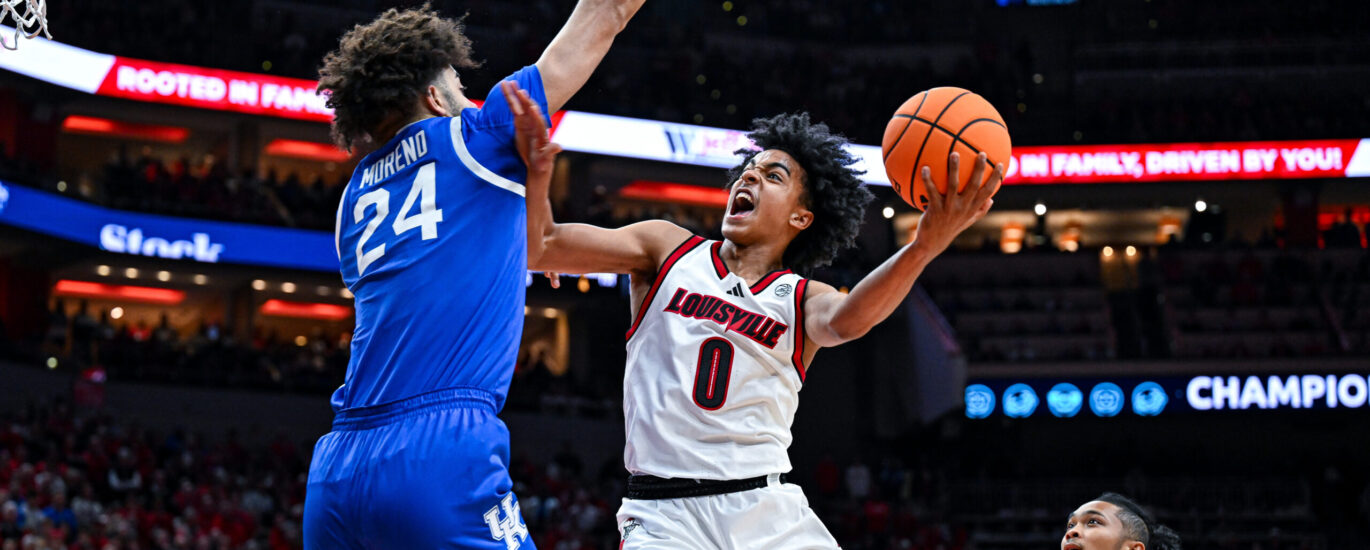
Louisville basketball star Mikel Brown showed Cards fans the good, bad, and ugly sides of life with five-star talent in the modern era.
TWENTY-FOUR HOURS BEFORE MIKEL BROWN is expected to become an NBA lottery pick, the defining image of the former Louisville basketball star’s legacy isn’t a highlight-reel finish or a deep three-pointer from the logo.
It is an empty chair.
On Tuesday night, when the flashing cameras illuminate the green room, the sleek designer suits, and the weeping families embracing at circular tables, Pat Kelsey will not be there. The coach who made Brown the centerpiece of the Louisville basketball resurrection. Kelsey, who relentlessly recruited him, publicly championed him, and watched him grow into one of the most electric freshmen in the country, acknowledged this week that he will be watching from afar.
When pressed on his absence, Kelsey pointed strictly to the player’s inner circle. “Kel has a very, very, very close-knit family,” Kelsey noted in an offseason presser Monday. “And there’s only so many spots and so many seats there.”
Perhaps that’s exactly what happened. NBA Draft “green room” seating is limited. Louisville coaches have opted out or been left out of green room appearances before.
Kenny Payne and Chris Mack never had lottery picks. Rick Pitino watched Donovan Mitchell’s draft night from afar, while Terry Rozier and other fringe draftees did not get green room invites. Denny Crum had 13 first-round picks, but the modern green room structure did not yet exist.
Still, this opportunity for Kelsey and the program should not be overlooked. Duke’s Jon Scheyer has attended in the past. John Calipari famously attended drafts in past years. Houston’s Kelvin Sampson is confirmed to be attending despite a busy schedule. Coaches often take advantage of the moment to spend the big night with the stars that they helped mold. If not to be there modestly in support, at the very least to remind the next wave of future stars who helped get their predecessors into a room that hands out 24 annual invites.
Even with space being limited backstage, if Kelsey and company wanted to get in (or were wanted to be there), they most certainly would be in attendance.
If Louisville knew it stood something to gain from an appearance, trust that its administration would have seen to soaking in the spotlight. In most cases, associating and aligning your brand with the best talent is a winning equation.
With everything Louisville experienced over the past eight months, it’s difficult not to see the chair Kelsey could have filled as a physical manifestation of a quiet distance.
The initial script read as Louisville basketball’s redemption arc. A five star savior arriving to heal a proud but broken blue-blood program, dominating the ACC, and riding a roaring wave of community adulation straight into the lottery.
Instead, Brown’s lone year at Louisville became a case study for the modern collegiate landscape: Equal parts exhilarating, transactional, controversial, and, ultimately, unfinished.
Act I: The Savior
IT ALMOST COULDN’T HAVE STARTED ANY BETTER. From the moment Pat Kelsey accepted the monumental task of rebuilding Louisville basketball from bedrock, Mikel Brown was the blueprint. Landing a five-star virtuoso with effortless lottery gravity wasn’t merely a recruiting victory but a flag planted in the hardwood. It was a loud, defiant declaration that Louisville was back in the national conversation.
Brown wore the validation easily. He embraced the heavy crown, flashing a sharp, unmistakable swagger from the moment he arrived on campus. Kelsey fed the engine, praising the freshman at every turn, marveling at a basketball maturity that defied his teenage years.
When the lights were brightest, Brown delivered on the hype. He didn’t just play; he conducted. He stretched defenses out to thirty feet, split double-teams with predatory precision, and attacked the rim without a trace of fear. He became Louisville’s ultimate drink stirrer—the singular player capable of changing the entire temperature of an arena in a span of three possessions. Need a dagger from the logo? Brown. Need someone to absorb contact, finish the glass, and draw the whistle? Brown. Need to ignite a game-changing run? Brown can do that.
His masterpiece came against Kentucky. On college basketball’s most unforgiving stage, against the program’s fiercest rival, Brown looked entirely at peace. He hunted mismatches, dictated the tempo, and orchestrated a signature blowout victory that felt like a collective exorcism for the Louisville fan base.
The records tumbled next. He tied Wes Unseld’s legendary single-game scoring mark. He shattered the freshman scoring record. Sure, there were standard teenage growing pains. Turnovers that came in bunches, forced looks, and erratic defensive rotations. But those pains were minor static on a brilliant broadcast. When Brown was rolling, Louisville basketball looked like a Final Four contender. The vision was fully realized.
Then, the music stopped.
Act II: The Cold War
IN THE LEXICON OF COLLEGE SPORTS, Brown’s lower back injury seemed like a standard bump in the road on a long title quest journey. Rest him, rehab him, and unleash him in March. Instead, the medical report slowly mutated into the defining storyline of the season.
When Brown initially returned from his brief absence, he was superhuman. He tore through one of the most explosive scoring stretches in program history: 45 points, followed by 29, 29, 19, and 24 points. All told, Brown averaged 29.2 points, 4.8 rebounds, and 3.2 assists in a five-game stretch. It appeared Louisville had re-engineered its superstar at the absolute perfect moment.
Then, just as suddenly as he had reappeared, he vanished. Brown returned to the bench, and as the weeks dragged on, he never checked into a game again.
This vacuum of information naturally birthed its own toxic narrative. Programs do not owe the public every line of a medical chart, and teenagers deserve privacy, but silence in a sports town is a volatile element that can spiral an otherwise controllable narrative into an unfollowable web of misinformation.
The disconnect soon manifested visually on the Louisville bench. During a critical stretch of league play, Brown was on the bench enjoying his time. Louisville’s star was vibrant, smiling, standing throughout games, and enthusiastically high-fiving teammates during timeouts. Even the more lenient fans noted Brown moving, dancing, jumping, and running without any visible discomfort.
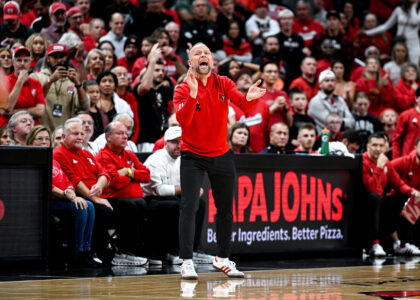
On the floor, his coach was sweating through his team-issued polo, forced to convert off-ball guards Ryan Conwell and Adrian Wooley into primary ball-handlers. Louisville basketball fought, scraping out an ACC Tournament win and an NCAA Tournament victory, but the offense lacked its engine. They lacked the creator who could collapse a defense off the dribble and score when nothing existed.
As Louisville staggered to and through the postseason, the questions grew louder outside the lines. Brown was promised for the end of the season. Then, he’d be ready by the ACC Tournament. After that, it was the NCAA Tournament. Brown arrived in apparent good spirits on the team’s round of 64 trip to Buffalo. Soon after arrival, UofL announced Brown would ultimately not suit up for the Cards. Still, he warmed up and practiced at a brisk pace in front of fans and media. But, again, shut it down when the moment mattered most. Act I’s savior was being waved in fans’ faces, but Act II left fans trying to grip hold of a ghost.
Act III: The Transactional Era
FRUSTRATION FROM THE FANBASE wasn’t just about basketball. It was about the shifting economics of the sport. Brown reportedly secured millions of dollars in NIL compensation to play his lone season at Louisville.
In the modern era, multi-million-dollar compensation calls into question the psychological contract between fan and athlete. Traditional loyalty is dead. Replaced by corporate transactions and young players eager to get their cut of the pie.
When an “amateur” player is compensated like a professional, the public begins to evaluate them through a ruthless professional lens. While other high-profile stars across the country played through pain or risked their bodies for hopes of a deep tournament run, Brown’s camp took the hyper-rational, protective business approach.
The national media took notice. On CBS Sports’ Eye on College Basketball podcast, the sport’s most connected insiders openly pulled back the curtain on the friction in Louisville.
“I’ve had enough conversations with sources at this point where… it did not go smoothly at Louisville,” Matt Norlander reported bluntly. “There are plenty of people who are of the understanding that… there was some shutting down… when they could have avoided that.”
Adam Finkelstein jokingly interjected that Norlander was going to get some angry texts. Brown’s camp has become infamous for its hypercritical tone, and its overwhelming social media responses to anything perceived to be critial of Brown.
Co-host Gary Parrish drove home a similar sentiment. “The Mikel Brown stuff was just, ‘We don’t really care about college. We’re headed to the NBA. We’re just here because we had to be somewhere’,” Parish explained. “When you’re getting paid millions of dollars to play college basketball, I think you should play college basketball.”
Yet, in a cruel twist that defines modern basketball, those same analysts spent the remainder of the episode raving about Brown’s professional upside. Finkelstein called him “one of the best kids in this draft to talk to,” predicting he would interview flawlessly and noting he possesses “the highest ceiling” of any guard in the lottery, pointing to his dominant USA Basketball film as the ultimate proof.
An Unfinished Symphony
TWO THINGS CAN BE entirely true at once. Mikel Brown can be an exceptional person, an elite teammate, and a future NBA All-Star. Concurrently, Louisville basketball fans have every right to feel burning resentment over how a potentially historic season was compromised by a premature business-driven shutdown.
Kelsey can genuinely want his former player to succeed on Tuesday night while harboring deep, professional frustration over how his roster was left stranded in March.
On Tuesday night, NBA President Adam Silver will read Brown’s name. Brown will walk across that stage, adjust a freshly minted NBA cap, and shake the commissioner’s hand. Millions of viewers will witness the culmination of a lifelong dream.
Louisville fans will tune in, and many will cheer. They will remember the 45-point explosion and the absolute destruction of Kentucky. But years from now, when historians look back at this brief intersection, they won’t just look at the stat sheet.
They will remember the contrast. A relationship born out of absolute, fiery alignment with national championship aspirations, but that ended in quiet, corporate distance. A future lottery pick whose most fascinating college legacy wasn’t what he did on the floor, but the mystery of why he walked away from it. A player and his camp that checked out of college basketball weeks too soon, choosing instead to check in to the business of themselves.
Until the principal actors decide to speak the truth, the Mikel Brown saga remains exactly what it feels like today on the eve of the draft: Not an outright failure. Not a seamless success. Just another transactional story that feels painfully unfinished.
On Tuesday night, the chapter of Brown’s legacy in the Derby City will conclude. Louisville fans will happily turn the page. Remaining, however, will be another asterisk, another “what if”, and the feeling of another promising season escaping their grasp.
A new season will bring new faces to Louisville, and a new franchise will inherit a brilliant talent. But as the curtain falls on this brief, transactional marriage, nothing speaks louder than the chair left empty.